Estimated Reading Time: 10 minutes
Alcohol detectors, commonly called breathalyzers, measure how much alcohol is in your system by analyzing your breath. This simple-sounding device actually relies on clever chemistry and electrical engineering to estimate your Blood Alcohol Concentration (BAC)—the percentage of alcohol in your bloodstream.
Most people think breathalyzers magically read your blood through your mouth, but that’s not quite right. Your lungs are the secret. When you breathe, alcohol vapors from your blood exit through your lungs and into your breath. A breathalyzer captures this vapor, analyzes it, and translates the data into a BAC reading in seconds.
Why Breathe Instead of Testing Blood?
Law enforcement loves breathalyzers because they’re fast, portable, and don’t require needles. Testing blood means finding a nurse, waiting at a clinic, and dealing with biohazard waste. A breathalyzer test takes 30 seconds roadside. That’s why police departments have made them standard for DUI screening nationwide.
The relationship between breath alcohol and blood alcohol is surprisingly reliable. Scientists discovered that the ratio stays fairly consistent: about 2,100 units of breath alcohol equals one unit of blood alcohol. This breath-to-blood ratio is baked into every breathalyzer’s calculations, which is why the device can estimate BAC without touching actual blood.
Three Main Technologies: How They Differ
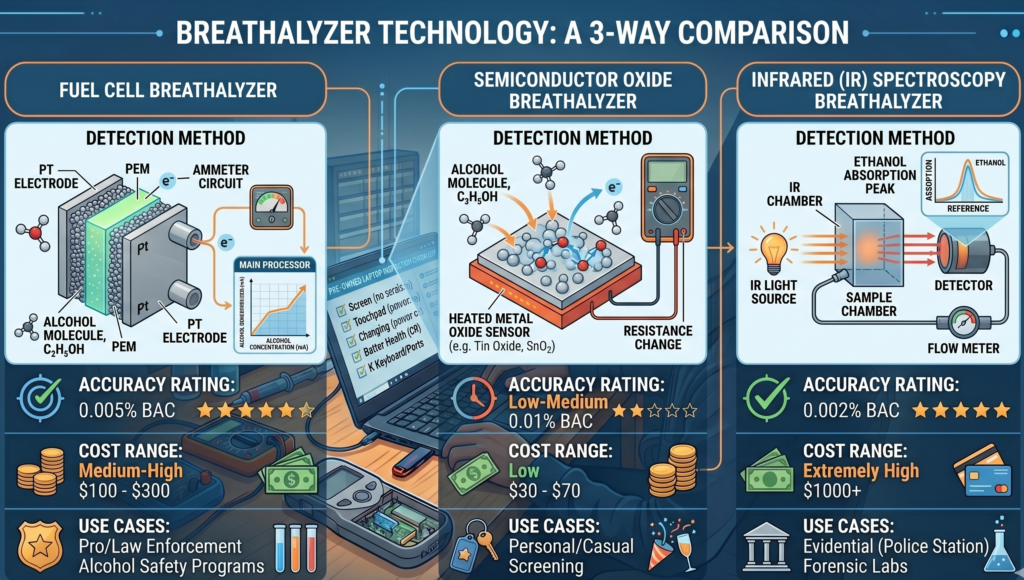
Modern alcohol detectors use three fundamentally different approaches to measure alcohol vapor. Each has distinct advantages, accuracy levels, and ideal use cases.
Fuel Cell Sensors: The Gold Standard
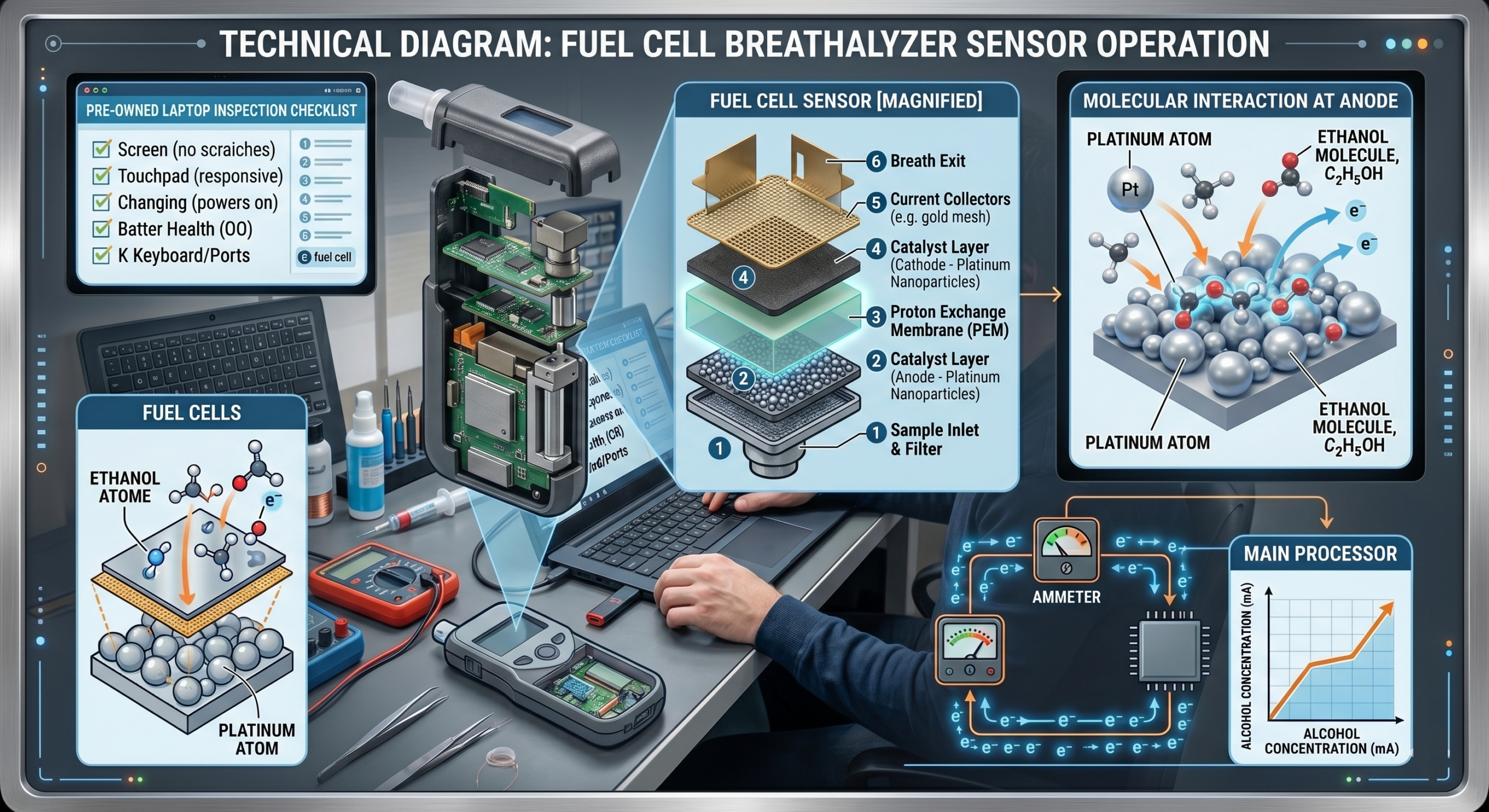
Fuel cell breathalyzers use electrochemical oxidation to detect alcohol—the same chemical process that powers hydrogen fuel cells. Here’s what happens inside:
When you exhale into the device, alcohol molecules hit a platinum electrode coated with an acidic chemical. The alcohol oxidizes (chemically breaks apart), creating electrons and hydrogen ions. This generates an electrical current directly proportional to alcohol concentration. More alcohol in your breath equals more electrons flowing, producing a stronger electrical signal.
Law enforcement agencies rely on fuel cell models like the Alco-Sensor FST because they’re incredibly accurate and produce readings admissible in court. The catch? They cost $500–$2,000 per unit and require calibration every 6–12 months. For that reason, fuel cell breathalyzers stay locked up in police stations, not personal cars.
Semiconductor Sensors: The Affordable Option
Consumer breathalyzers like BACtrack use semiconductor oxide sensors—typically made of tin dioxide. Here’s how they work:
The semiconductor material has a specific electrical resistance when alcohol-free. When alcohol vapor touches the sensor surface, it chemically reacts with the material, changing its electrical resistance. The device measures this resistance change and converts it into a BAC estimate.
Semiconductor sensors cost just $20–$100, which is why they dominate the personal breathalyzer market. They’re fast, portable, and accurate enough for personal safety checking. The trade-off? They’re less accurate than fuel cell models and can be confused by mouth residue (food, mouthwash, etc.) that might temporarily spike readings.
Pro tip: Wait 15–20 minutes after eating or drinking anything except water before testing with a semiconductor device. Residual compounds in your mouth can give falsely high readings.
Infrared Spectrometry: The Precise Method
Intoxilyzers—the devices you might see in a police station for official testing—use infrared spectroscopy. Instead of chemical reactions, they measure how infrared light bends when it passes through alcohol molecules.
Here’s the physics: Every chemical compound absorbs infrared light at specific wavelengths. Alcohol has a unique infrared signature. The device shines infrared light through a breath sample, measures how much light gets absorbed at alcohol’s signature wavelength, and calculates concentration from that absorption.
Infrared methods are extremely accurate because they measure alcohol directly without chemical reactions creating interference. Law enforcement uses them for official BAC determination because results stand up in court. They’re lab-quality devices that cost $5,000+, so you won’t find them in consumer products.
The Complete Testing Process: Step-by-Step
Understanding how your breath gets from your lungs to a BAC reading reveals why timing and technique matter.
Step 1: Deep Lung Air
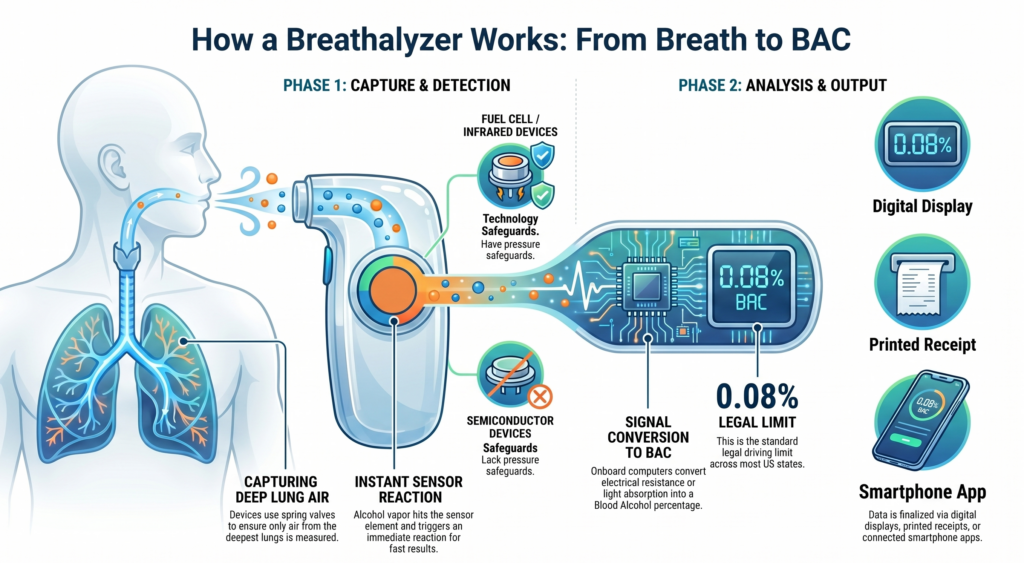
When you breathe normally, air from your mouth mixes with air from your lungs. For accurate testing, you need deep lung air—breath that comes directly from the deepest part of your lungs where gas exchange happens. Shallow breath from your mouth cavity contains different alcohol concentrations.
Fuel cell and infrared devices use spring valve mechanisms that wait for sufficient air pressure before triggering measurement. This ensures they capture deep lung air, not mouth air. Semiconductor devices don’t have this safeguard, making technique more important for accurate readings.
Step 2: Sensor Exposure
Your exhaled breath hits the sensor chamber where alcohol vapor contacts the detection element. The sensor reaction happens instantly—it’s not waiting minutes for a chemical process. This is why modern breathalyzers give results in seconds rather than the minutes old chemical-strip devices required.
Step 3: Signal Conversion
The sensor generates an electrical signal (current, resistance change, or light absorption) proportional to alcohol concentration. The device’s onboard computer converts this signal into a BAC percentage. A semiconductor device might show “0.08 BAC” meaning 0.08% alcohol in blood, which is the legal limit for driving in most US states.
Step 4: Display and Recording
Handheld devices show results on small screens. Police breathalyzers print receipts with timestamps, device identification, and officer notes. Smartphone-connected models send data to apps that track readings over time.
Factors That Affect Accuracy: What You Should Know
Breathalyzer readings aren’t perfect. Several real-world factors influence accuracy, which matters if you’re making driving decisions based on results.
Mouth Alcohol Contamination
Residue from alcohol consumption stays in your mouth for 15–20 minutes after drinking. If you belch or don’t wait long enough, this mouth alcohol gets measured along with genuine breath alcohol, inflating readings. This is why both defendants and police sometimes request waiting periods before testing.
Breathing Pattern
Rapid, shallow breathing produces different readings than slow, deep breathing. You’re supposed to exhale completely and continuously into the device to ensure consistent deep lung air reaches the sensor. Hiccupping, coughing, or irregular breathing can skew results.
Environmental Factors
Temperature affects semiconductor sensors noticeably. Testing in a car interior that’s 100°F versus 70°F can influence readings slightly. Humidity also matters for fuel cell sensors. These environmental sensitivities are why professional devices require controlled conditions.
Calibration Status
An uncalibrated breathalyzer is basically a paperweight. Fuel cell and semiconductor sensors drift over time and require recalibration every 6–12 months. A personal breathalyzer that’s never been calibrated might read 0.12 BAC when you’re actually at 0.08 BAC.
Individual Physiology
The 2,100:1 breath-to-blood ratio works on average, but individuals vary. Some people have naturally higher or lower ratios based on body fat percentage, lung capacity, and metabolism. This is why breathalyzer evidence in court gets challenged by expert testimony about individual variation.
Why Breathalyzers Get Challenged in Court
Despite their popularity, breathalyzer evidence gets successfully challenged more often than people realize. Smart defense attorneys understand the technology’s limitations.
Lack of Specificity
Breathalyzers measure ethanol vapor, but other compounds exist in breath that might register as alcohol to some sensors. Acetone (from dieting), isopropanol (from certain medical conditions), and other compounds can cause false positives—especially with cheaper semiconductor models.
Calibration Records
If a police breathalyzer hasn’t been properly maintained and calibrated, the defense can argue results are unreliable. Departments must keep detailed calibration logs and maintenance records. Missing documentation means results get excluded from evidence.
Testing Procedure Violations
Police have strict protocols: observation period (15 minutes of no drinking, eating, or smoking), two separate breath samples, proper mouthpiece changes between tests. If an officer skips steps or documents incorrectly, the reading gets thrown out in court.
Inherent Margin of Error
Even perfectly functioning breathalyzers have built-in accuracy margins. A fuel cell model might be accurate within ±0.005 BAC. That means a reading of 0.08 BAC could actually be 0.075–0.085. At the legal limit, this margin matters legally.
Modern Innovations: Where Breathalyzer Tech is Heading
The technology keeps evolving with new sensor materials and smarter devices.
Smartphone Integration
Companies now make wireless breathalyzers that connect to your phone via Bluetooth. You blow into a small handheld sensor, and results appear in an app that logs history. BACtrack Mobile and similar devices let drivers track their BAC before deciding whether to drive—a genuine safety innovation.
Disposable Paper Breathalyzers
Researchers have developed breathalyzers printed on paper using organic electrochemical transistors (OECTs). Imagine a glucose-test-strip style device you blow into once and toss. These are still in early stages, but they could eventually provide ultra-cheap, single-use breathalyzers for mass distribution.
Improved Selectivity
New sensor materials are becoming more alcohol-specific, reducing false positives from other compounds. Nanotechnology is creating sensors that ignore acetone and other interfering substances while accurately detecting ethanol alone.
Wearable Alcohol Monitors
Prototype wearable devices measure alcohol through skin vapor, eliminating the need to blow into anything. These aren’t commercially available yet, but they represent the future of continuous, passive alcohol monitoring.
Practical Tips: How to Get Accurate Results
If you’re testing yourself with a personal breathalyzer, these tips improve accuracy.
- Wait 15–20 minutes after your last drink before testing
- Don’t eat, smoke, or drink anything except water for 15 minutes before
- Use the same device consistently for comparison, since different devices read slightly differently
- Get your device recalibrated annually if you use it regularly
- Blow slowly and completely into the mouthpiece, not a quick puff
- Test multiple times and average the results if readings vary
- Never rely solely on a breathalyzer for driving decisions—when in doubt, don’t drive
Conclusion: Smart Technology with Real Limitations
Alcohol detectors represent clever engineering that solves a genuine safety need: quick, portable alcohol measurement. Fuel cell breathalyzers deliver courtroom-quality accuracy, semiconductor models offer affordable personal monitoring, and infrared devices provide the most precise lab-grade measurements.
That said, understanding how these devices work reveals why they’re not perfect. Mouth contamination, calibration drift, environmental factors, and individual physiology all influence readings. A breathalyzer gives you useful information for decision-making, but it’s not a foolproof blood test.
For law enforcement, breathalyzers work because they’ve been tested extensively, legally challenged repeatedly, and thoroughly understood by courts. For personal use, they’re valuable safety tools—as long as you recognize their limitations and use them correctly.
The next time you see a breathalyzer test on TV, you’ll know it’s not magic. It’s solid chemistry and smart engineering working together to answer one simple question: How much alcohol is in your system right now?
External Links: